
Concrete Demonstration Structures in Offenbach
Concrete Demonstration Structures in Offenbach
Concrete Demonstration Structures in Offenbach
Concrete without Iron
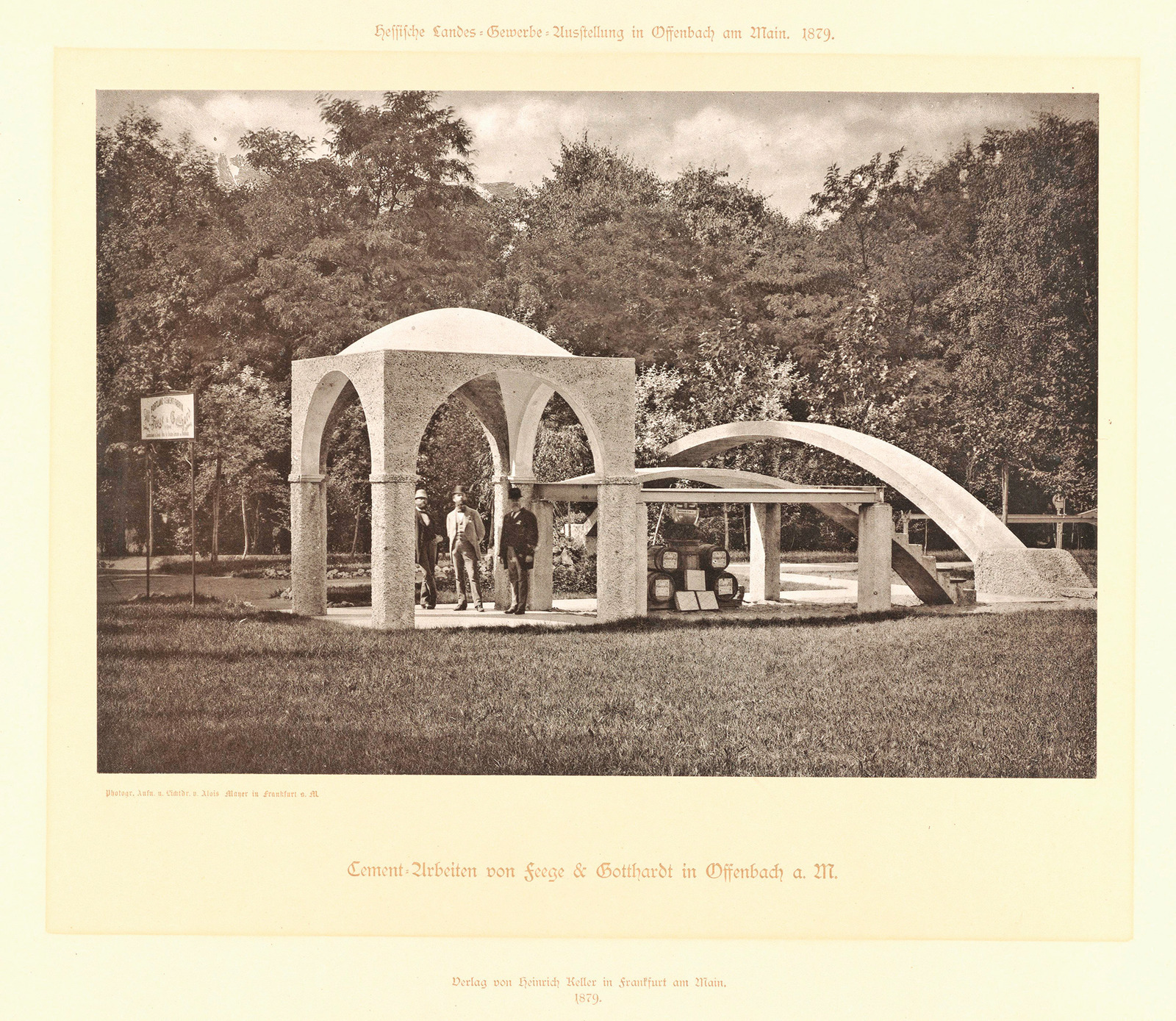
The demonstration structures at the Hessian State Trade Exhibition, 1879. Album Offenbach 1879, unpaginated.
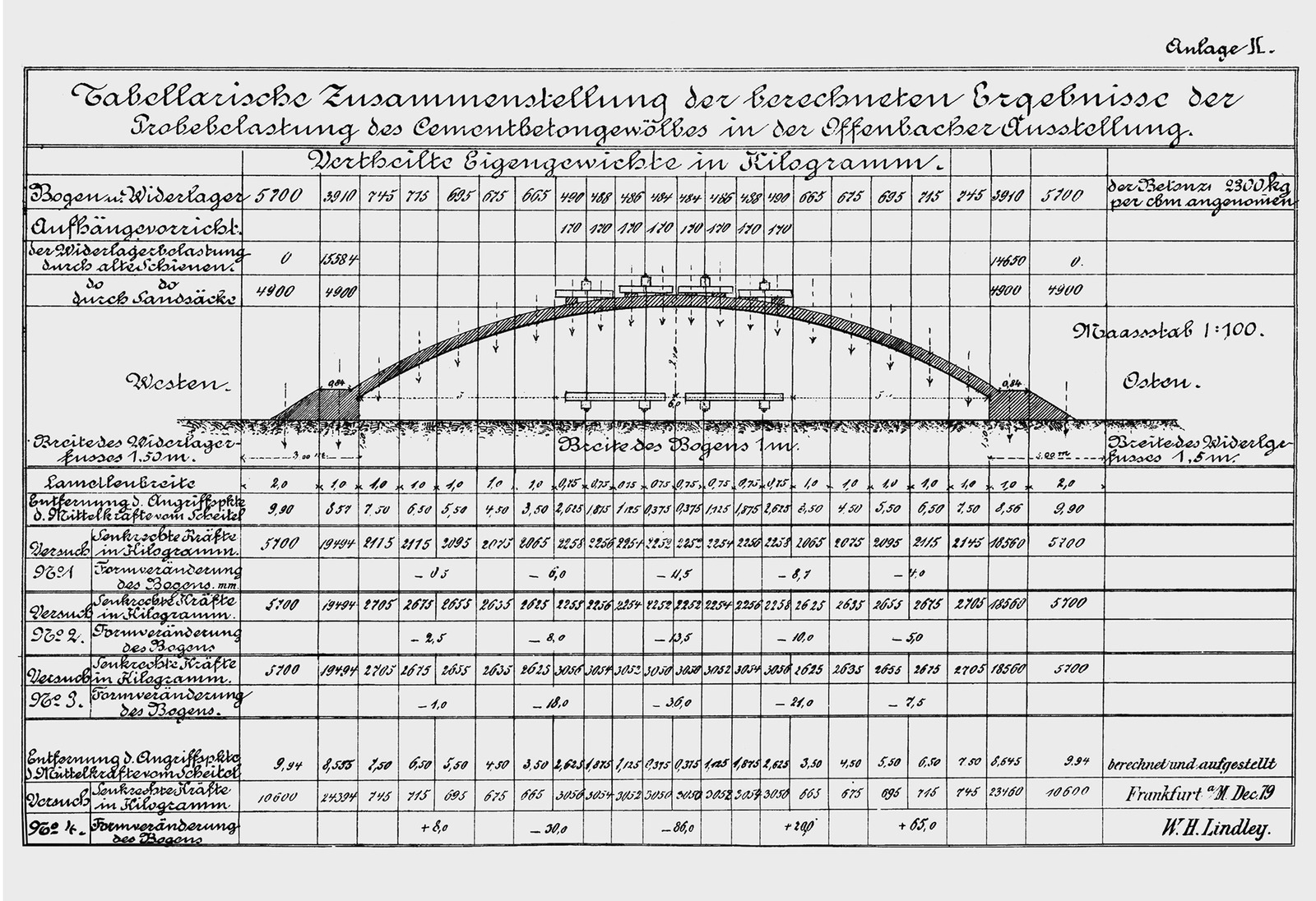
Presentation of the results of the load test on the large arch on 16 October 1879 in a company publication of W. Feege & Gotthard. Stadtarchiv Düsseldorf (Düsseldorf City Archives), 0-1-3-11059
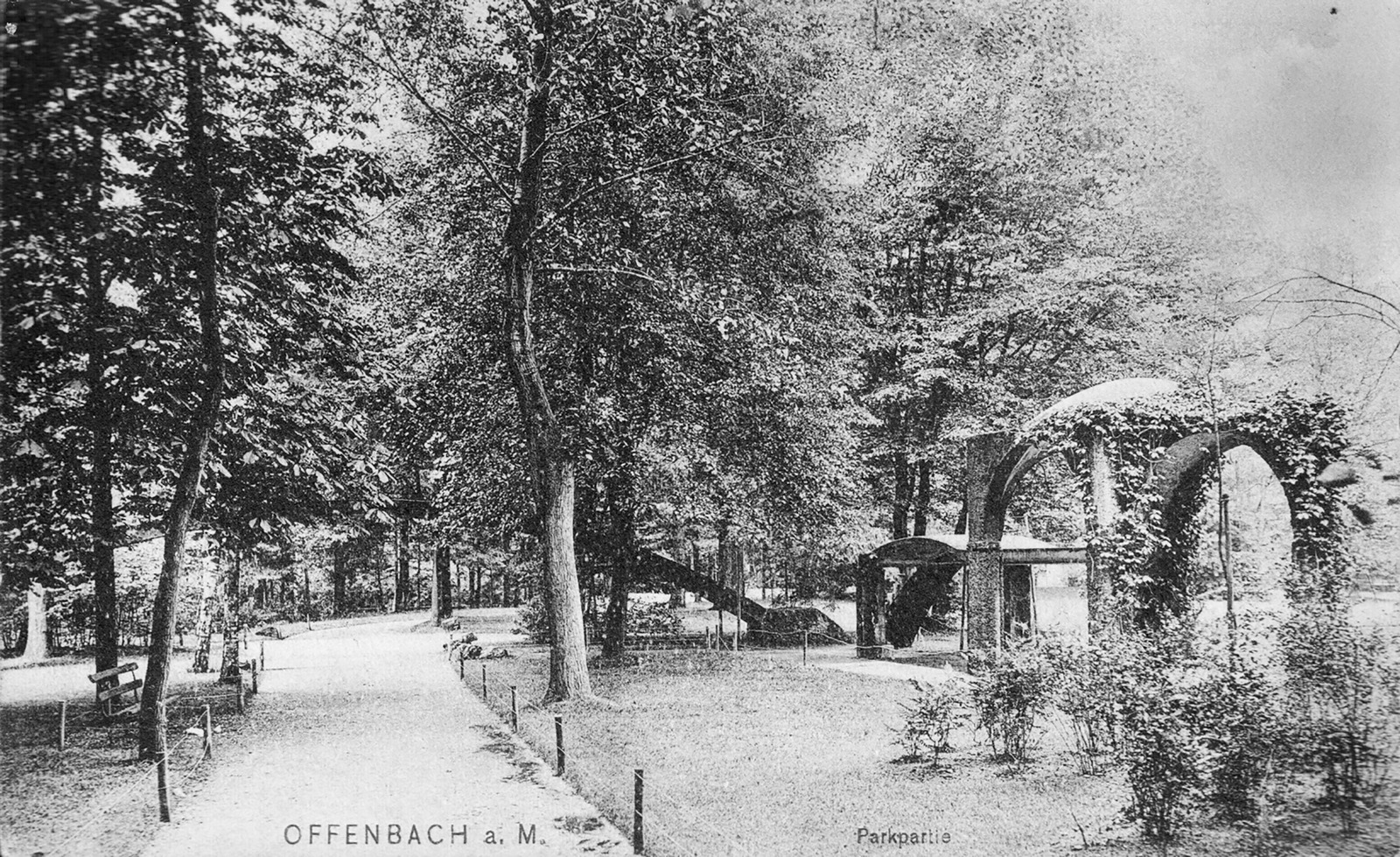
View of the group of structures before the first stabilization measures, around 1910. Historical postcard (Wikimedia Commons)
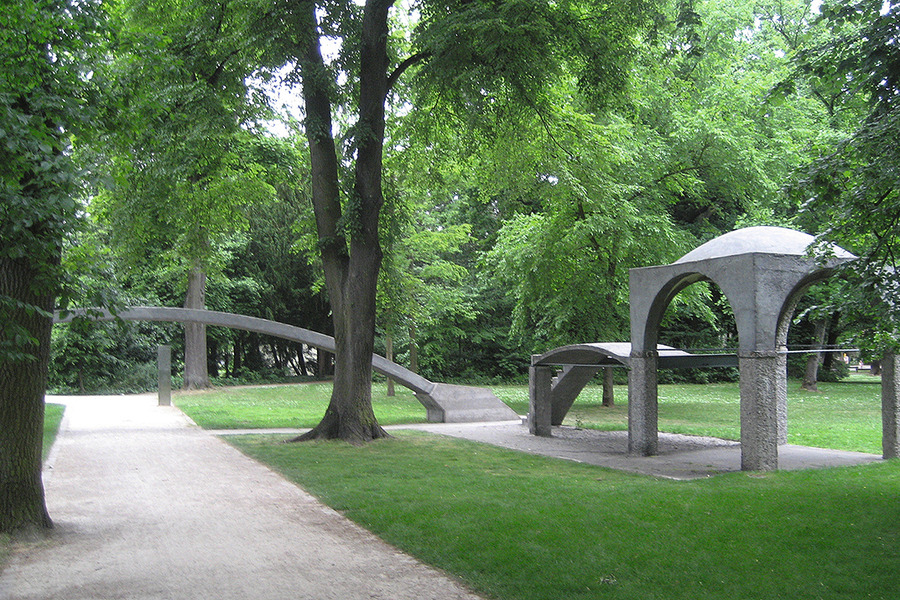
View of the group of structures after the most recent refurbishment to date, around 2010. Photo: Christos Vittoratos (Wikimedia Commons)
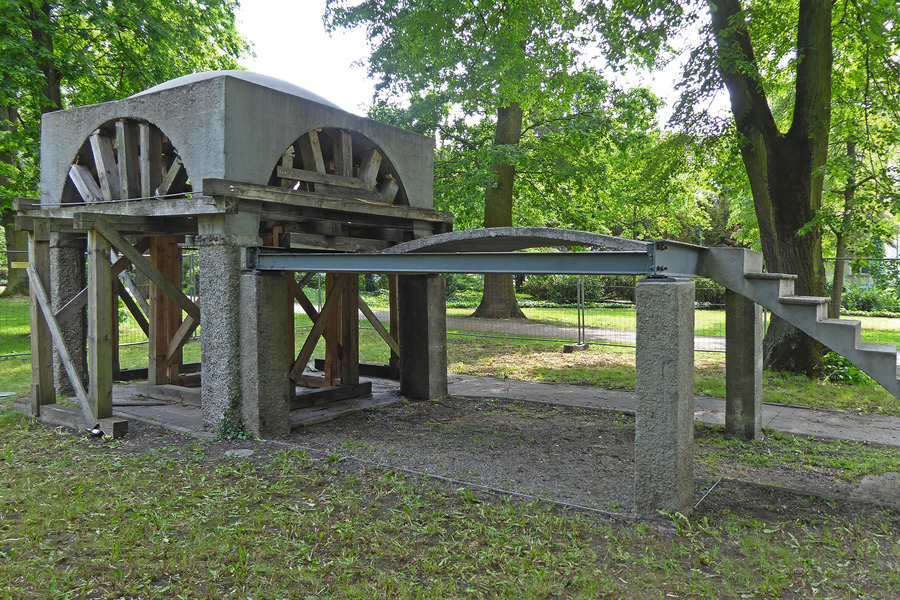
Pavilion with safety scaffolding, and annex, 2019. Photo: Philipp Grillich
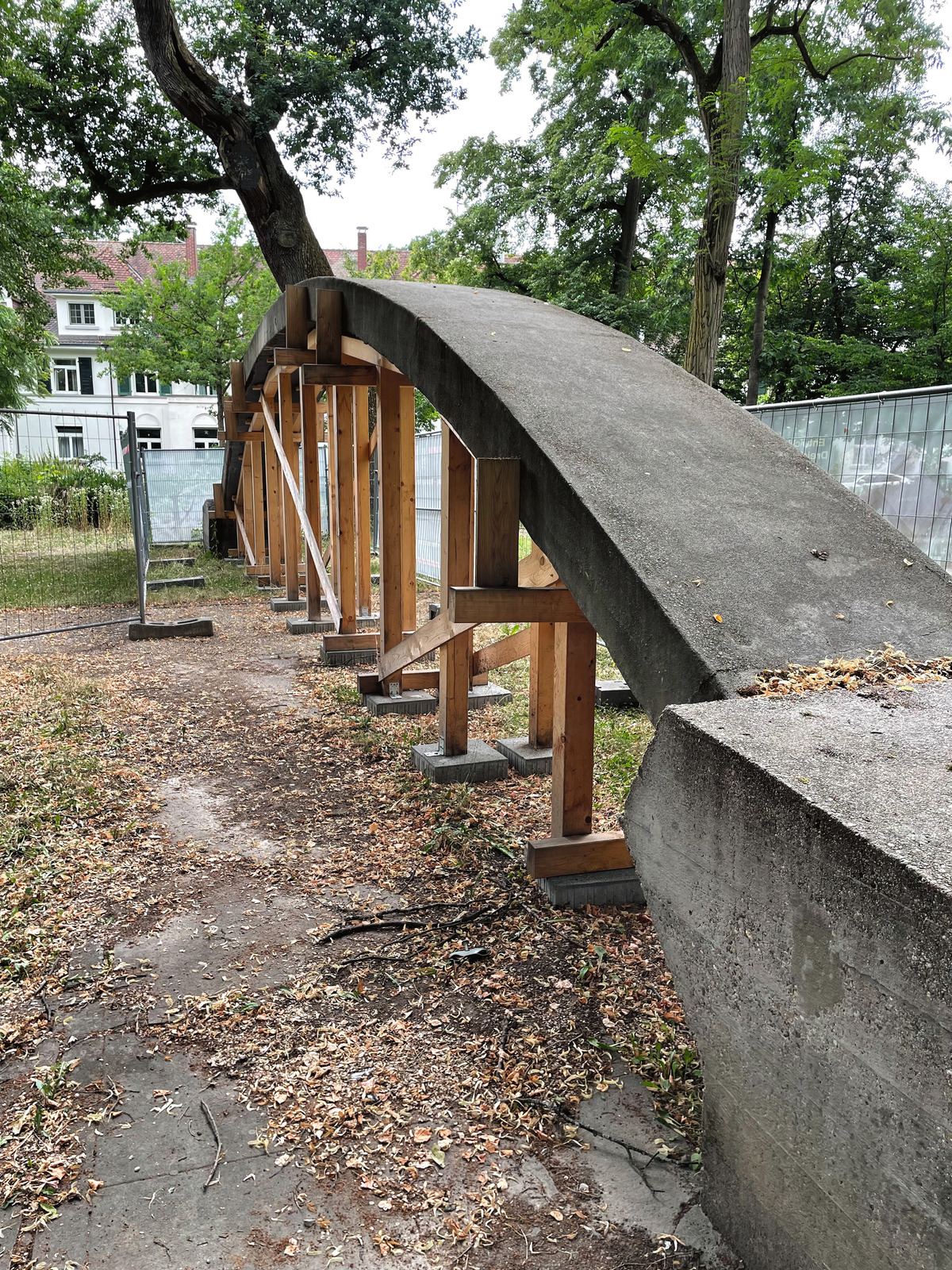
View along the large arch, which has meanwhile also been fitted with safety scaffolding, 2022. Photo: Philipp Grillich
In terms of construction history, they are small gems, built in 1879 for the Hessian State Trade Exhibition: to this day, the exhibits of the cement works W. Feege & Gotthard speak of the almost boundless expectations placed at the time on the technical and commercial potential of the new way of building with (still unreinforced) concrete.
The Building
The invention and rapid improvement of Portland cement in the course of the 19th century laid crucial foundations for building with concrete. The young construction industry countered initial reservations about the new material with numerous demonstration structures at trade and industrial exhibitions. Two particularly early examples were built in 1879 for the Hessian State Trade Exhibition in Offenbach. They survive at their original site to this day.
The structures were the work of the cement works W. Feege & Gotthard, founded only a few years earlier. Bearing a jaunty motto (“Als gut bereits zur Römerzeit erkannt / Und heutzutage noch so wenig angewandt” – “Recognized as good in Roman times already / And yet so little used today”), the buildings showcased not only the structural possibilities of concrete. Different kinds of surface treatment also demonstrated its potential for design. Architectural forms, however, are displayed only by a pavilion on a square plan with sides of approx. 3.5 m, roofed with a truncated dome. A half-height lateral annex, accessible via a concrete staircase, demonstrates two possible types of floor construction. Resting on iron edge beams are a slender segmental vault spanning about 4 m and – at right angles to it – a flat slab spanning 1.6 m. In addition, a “cement concrete vault” spans a park path between accentuated abutment blocks. With a clear span of 16 m, it is only 28 cm thick.
Construction
Even to today’s observers, the concrete structures, designed without any reinforcement, appear “springy and feverish” (Dieter Bartetzko). It was precisely for this reason that W. Feege & Gotthard had load tests carried out at the time on arches whose dimensions and span corresponded to the segmental vault shown here. The results appeared to confirm exaggerated expectations of the performance of concrete, as did a load test on the concrete vault after the exhibition closed. The following year, however, a bridge with a span of 22 m, built by W. Feege & Gotthard for the large Düsseldorf Trade Exhibition, collapsed after only a few months in service. The cause of the collapse was identified as inadequately founded footings, which had shifted under the thrust of the arch in ground softened by persistent rain.
Future
A similar fate could have befallen the Offenbach structures, which likewise optimistically pushed along the limits of what was feasible. Over time, numerous refurbishment campaigns were needed to secure all arched elements with tie rods, strengthen the foundations and repair or replace damaged components. Currently, there is once again a risk of collapse, and temporary support structures have been securing the concrete models for several years now. Discussions are ongoing as to how these unique witnesses to the beginnings of concrete construction in Germany can be secured for the future and made fully accessible to the public again.
Key Facts
Location: Dreieich-Park, Dreieichring, 63067 Offenbach am Main
Construction: 1879
Refurbishments: 1912, 1970, 1984, 2006
Structural design: presumably Bernhard Löhr
Construction and design: Portland-Cement-Fabrik W. Feege & Gotthard
Heritage status: Entered in the list of monuments in 1986 as part of the ensemble “Anlagenring Stadt Offenbach.”
Further Reading
[Carl] B[ernhard] Löhr: “Ueber Belastungsproben von Gewölbbögen.” In: Deutsche Bauzeitung 13 (1879), no. 71, pp. 358–361.
Knut Stegmann: Das Bauunternehmen Dyckerhoff & Widmann. Zu den Anfängen des Betonbaus in Deutschland 1865–1918. Tübingen / Berlin 2014, p. 68.
Philipp Grillich / Michael Auras: “Die Betonmodelle in Offenbach.” In: Industriekultur 30 (2024), no. 1, pp. 6 f.
