
Hohe Esse in Halsbrücke
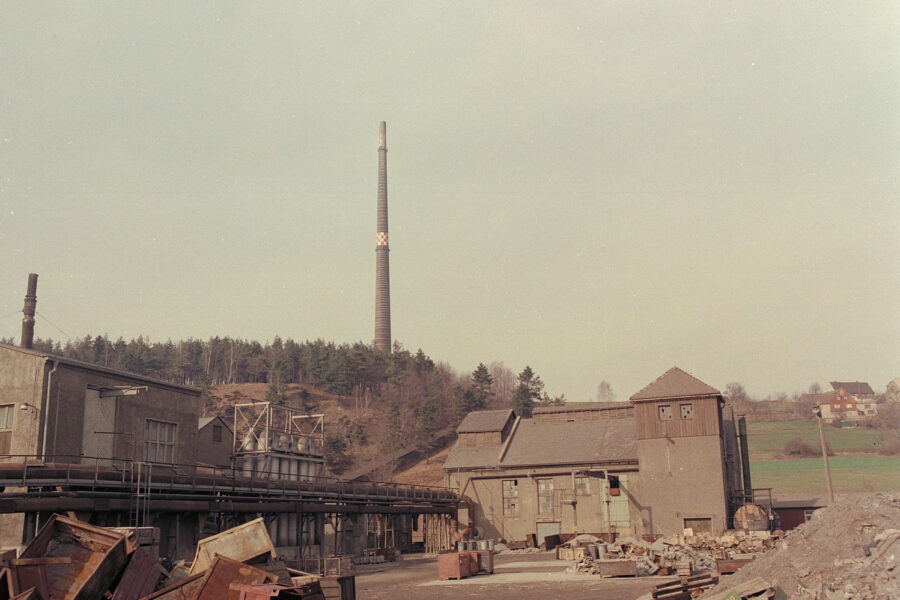
Hohe Esse in Halsbrücke
Hohe Esse in Halsbrücke
Once the Tallest Chimney in the World
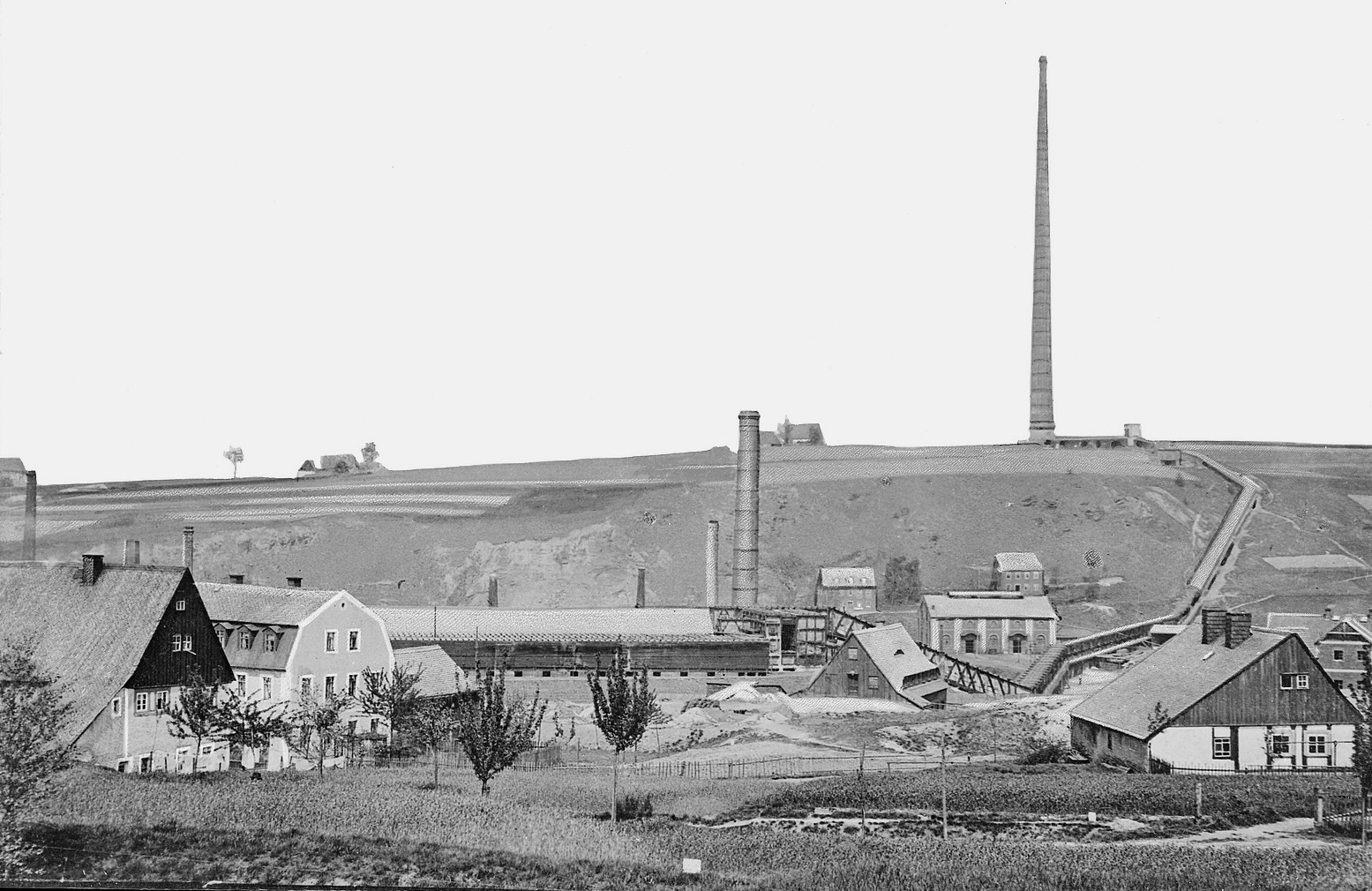
View from Halsbrücke towards the Hohe Esse, photographed in 1904.
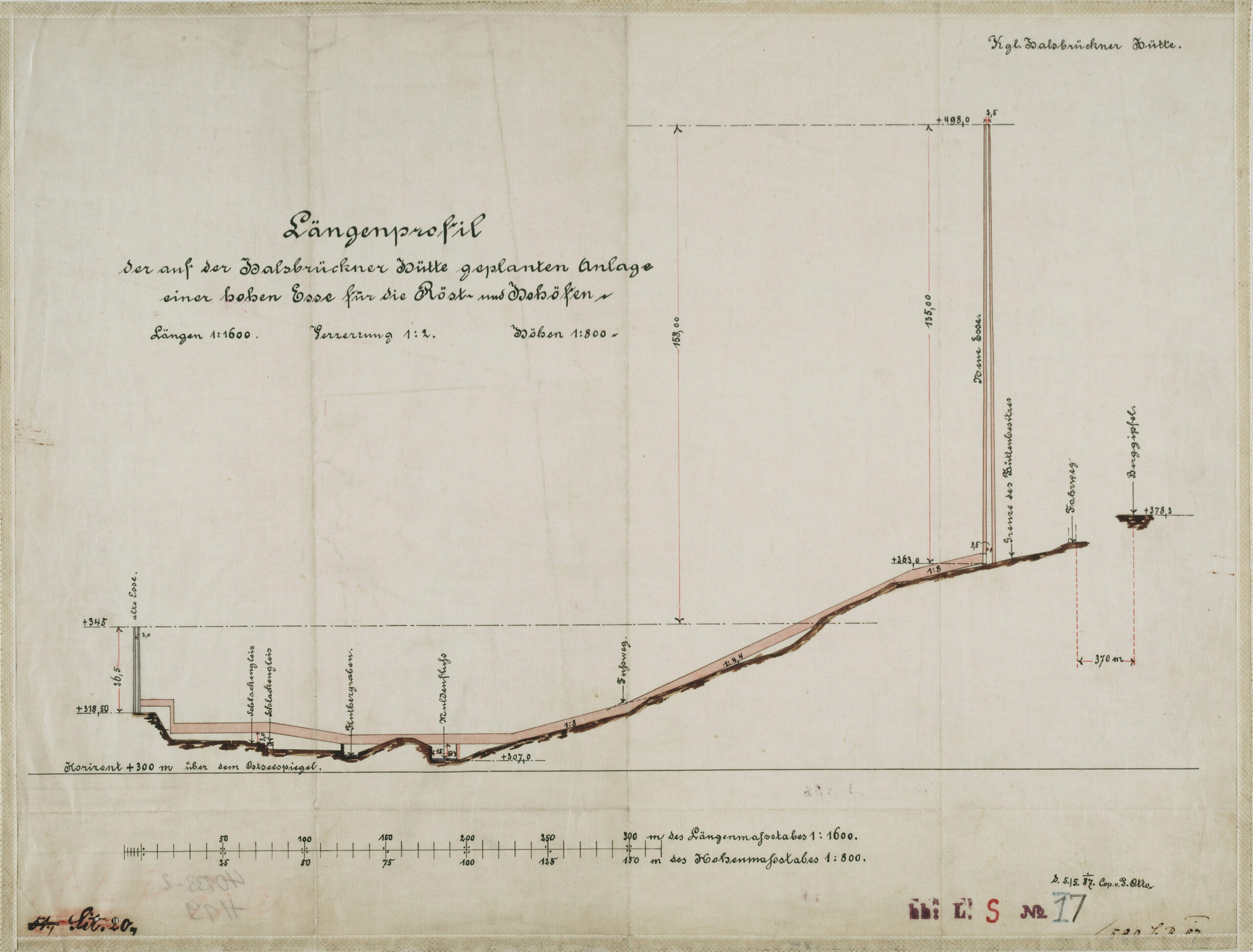
Longitudinal profile of the tall chimney planned at the Halsbrücke smelting works for the roasting and smelting furnaces.
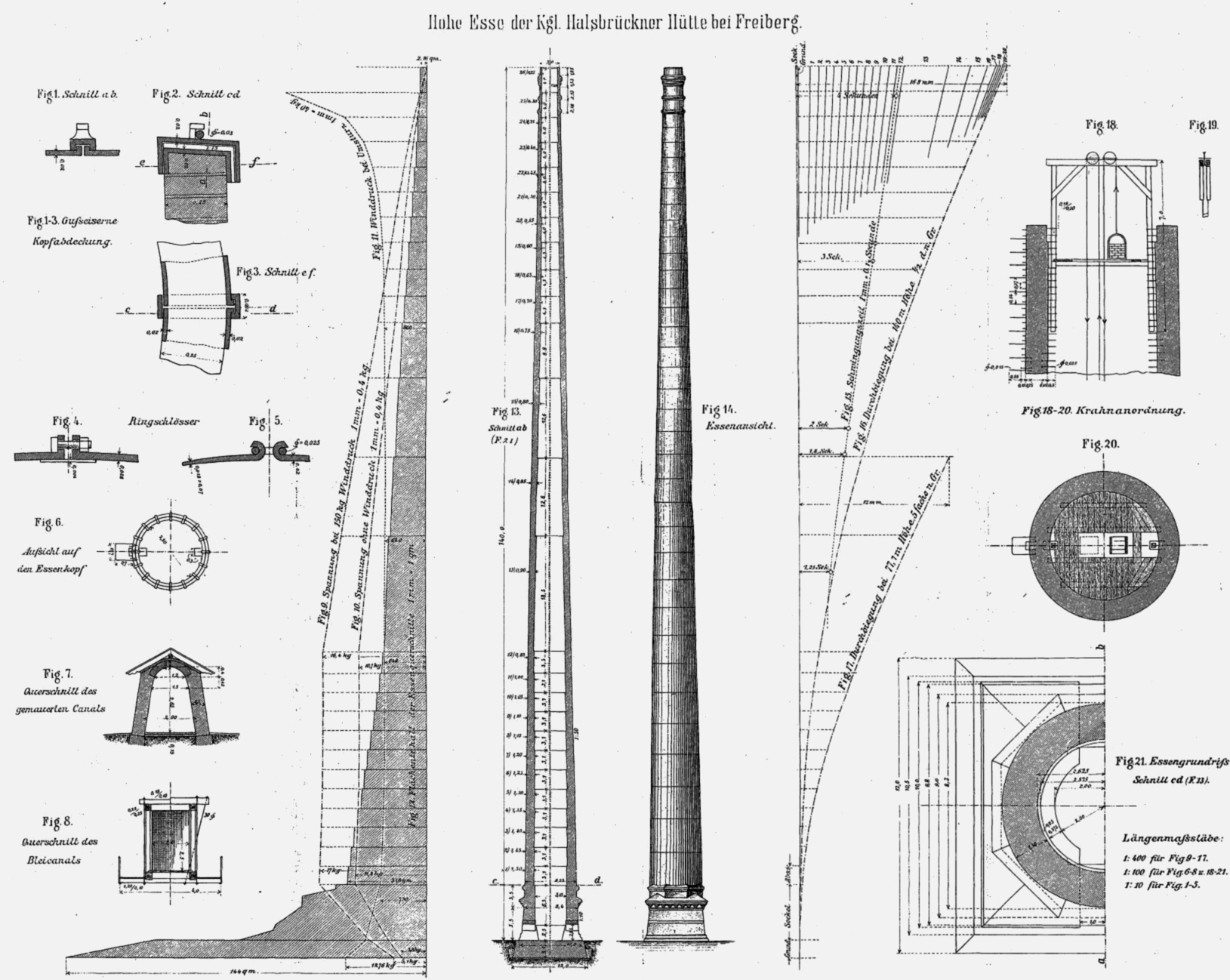
Construction drawing of the Hohe Esse with elevation, sections and details.
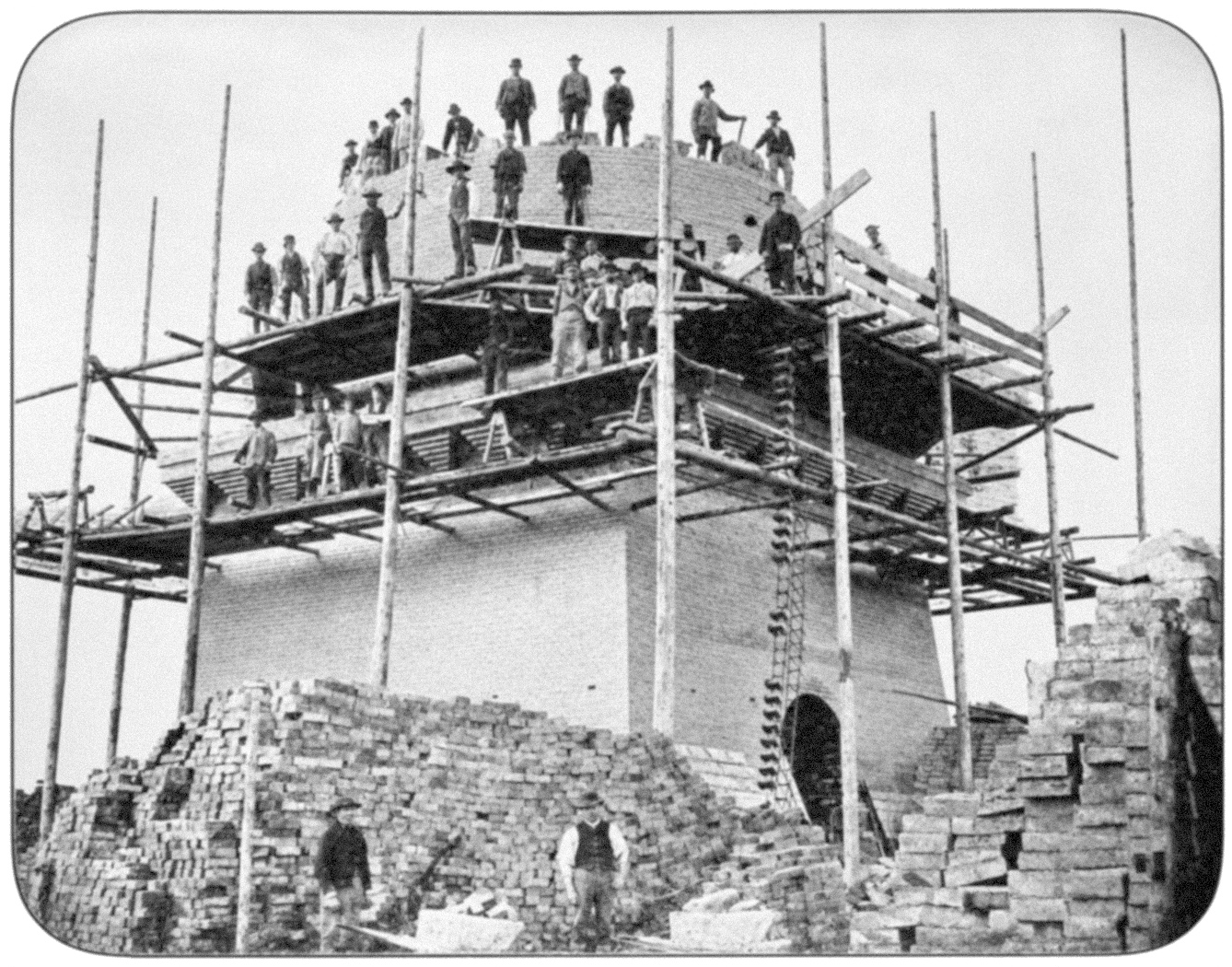
Construction of the Hohe Esse, photographed in 1889.
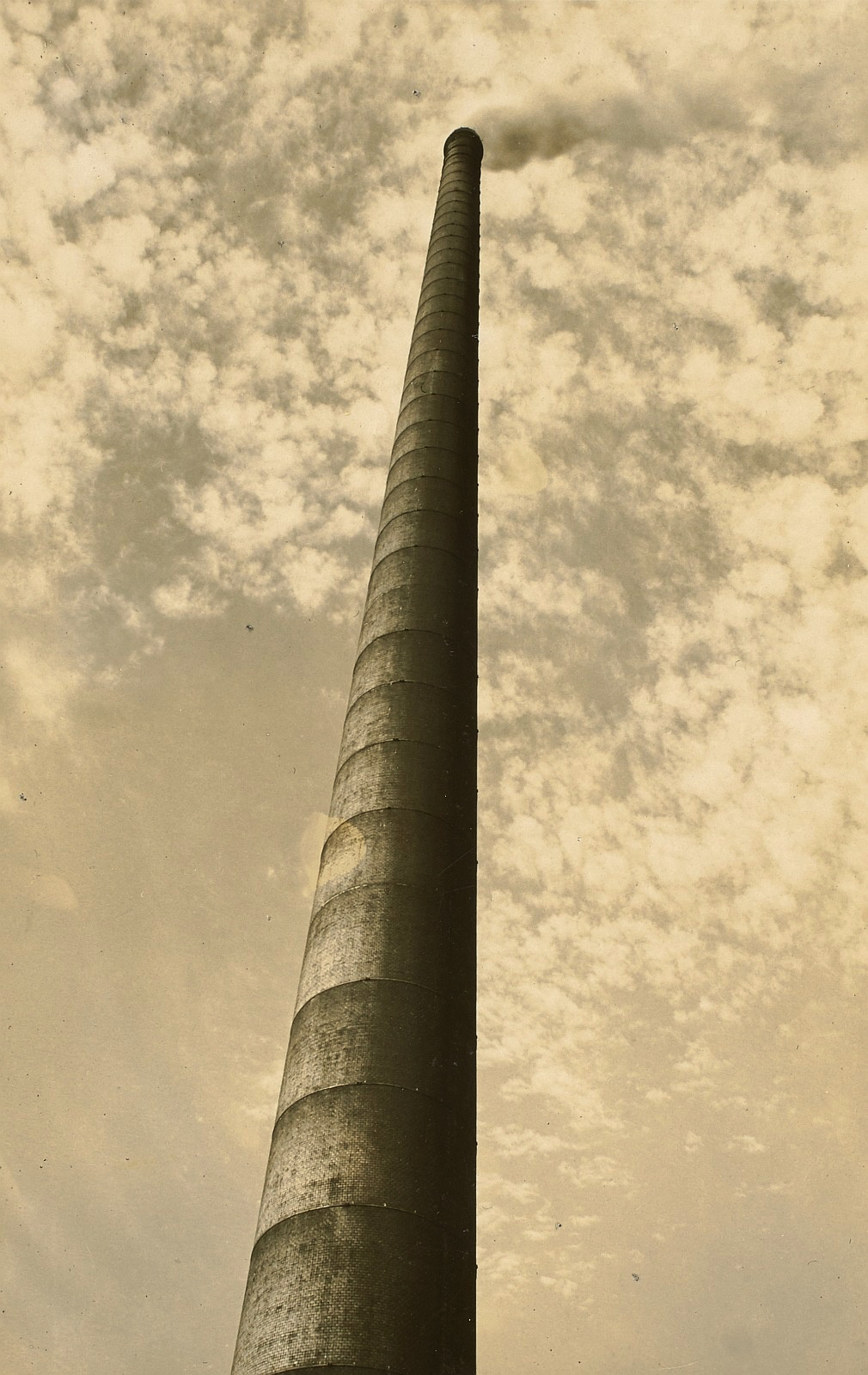
View of the Hohe Esse with its characteristic tension rings.
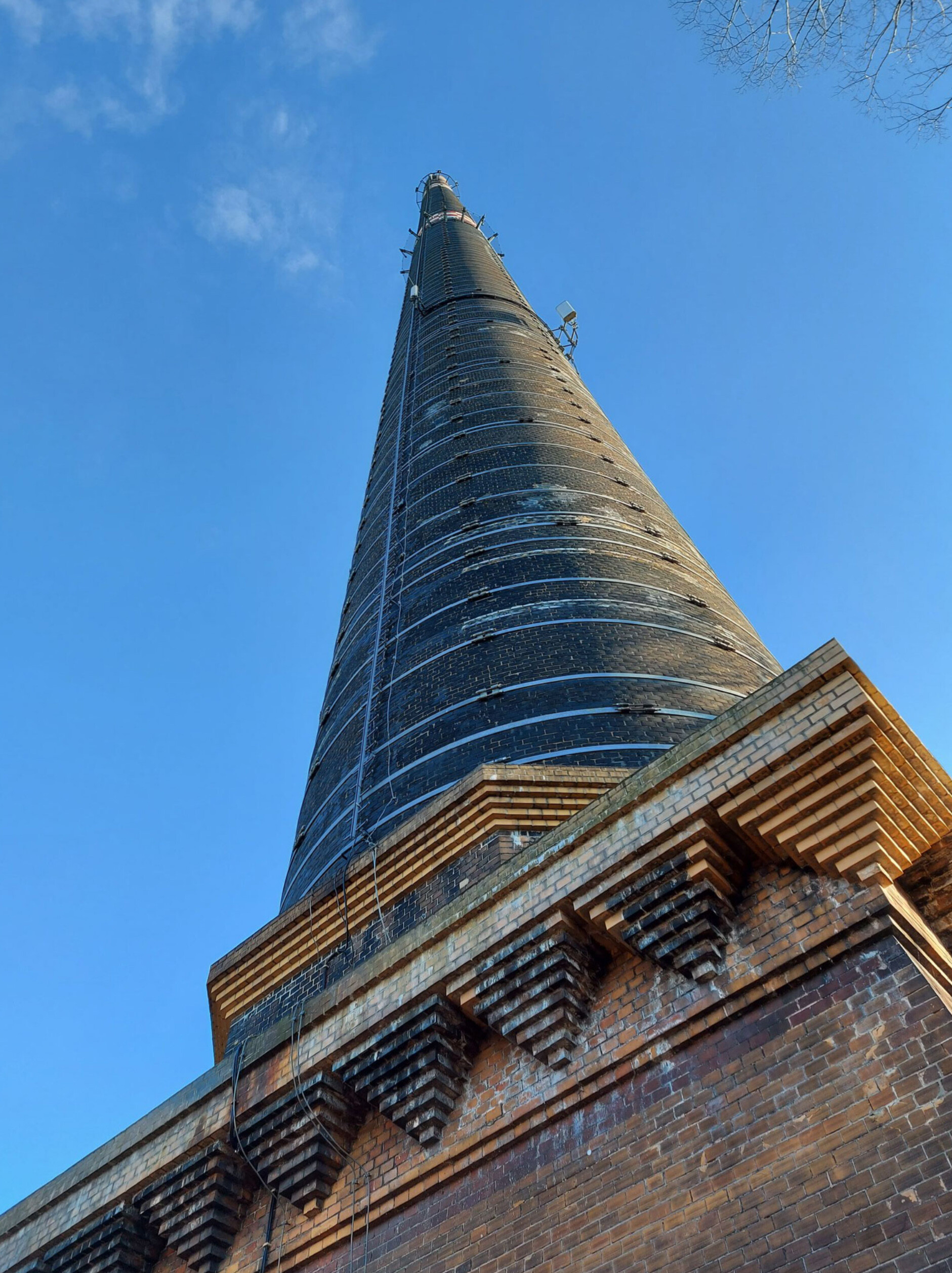
View upwards from the elaborately designed base. The number of tension rings has since been increased further; photographed in 2022.
Since 1890, the “Hohe Esse” (Tall Chimney) has carried flue gases from the smelting works in the Mulde valley into higher layers of the atmosphere. Once the tallest chimney in the world, the structure still shapes the former Saxon mining landscape around Freiberg today as an authentic testimony to industrial history.
The Building
The Hohe Esse was built towards the end of the 19th century as a technical response to a serious environmental problem. Various ores were smelted in the Halsbrücke smelting works, situated deep in the valley of the Freiberger Mulde. The flue gases released large quantities of dust containing arsenic and sulfur, causing massive damage to vegetation around the village. An exceptionally tall chimney was therefore erected some 60 m above the valley floor in order to carry the emissions over the surrounding hills.
With an overall height of 140 m, the Hohe Esse held the title of the world’s tallest chimney for around two decades. It is fed by a flue gas duct some 500 m long, known as the “Fuchs.” Starting from the smelting works, the duct first crosses the river on a lead-clad timber structure and then runs uphill as a masonry construction. It opens into a 9 m high base with a square plan, above which rises the stack proper. Its circular diameter tapers continuously from 8.25 m to just 3.0 m at the top, while the thickness of the load-bearing wall decreases from 1.5 m to a remarkably slender 25 cm. Cornices below the top, like the intricately structured walls of the base, bear witness to the design aspirations of this utilitarian architecture, which defines the townscape and landscape.
Construction
In technical terms, the structure was modeled on the large chimney of the Magdalenenhütte in Mechernich (“Langer Emil”), built shortly before, although here the exposed location placed particular demands on the structural analysis of a construction loaded purely in compression. The structure, weighing a good 5,400 t, was founded on the underlying gneiss bedrock, which was leveled with a thin layer of concrete. Although only a handful of bricklayers could work at the same time on the stack, which was built of radial bricks, more than one million bricks were laid in just 177 working days. To prevent open joints, the courses were inclined at right angles to the outer surface, which has a batter of 1:50. Iron tension bands, painted with red lead and spaced increasingly closely towards the top, were intended to prevent cracking.
Future
As the tallest surviving brick chimney in Europe, the Hohe Esse today strikingly marks the transition from craft-based, empirical construction to construction grounded in scientific theory. Despite – or precisely because of – regular repairs, the overall system of chimney, flue duct and canal bridge, which is still in use, also represents an exceptionally authentic testimony to early environmental technology in the metallurgical industry. The technocratic approach of the time is almost paradigmatic of High Modernism: although nature in the immediate surroundings of Halsbrücke recovered astonishingly quickly once the installation went into operation in 1890, the pollutant load subsequently caused new environmental damage in more distant forest areas for many years.
Key Facts
Location: An der Hohen Esse, 09633 Halsbrücke
Construction: 1888/89
Repairs: 1975, 2008, 2023
Structural design: Building administration of the smelting works (Oscar Hüppner, master builder of the Halsbrücke smelting works)
Contractor: Specialgeschäft für Fabrikschornsteinbauten H. R. Heinicke, Chemnitz
Heritage status: Entered in the list of cultural monuments of the Saxon State Office for the Preservation of Monuments (Landesamt für Denkmalpflege Sachsen) under object no. 08985257; since 2019 also part of the core and buffer zone of the UNESCO World Heritage Site Erzgebirge/Krušnohoří Mining Region.
Further Reading
Arne Andersen: Historische Technikfolgenabschätzung am Beispiel des Metallhüttenwesens und der Chemieindustrie, 1850–1933 [Zeitschrift für Unternehmensgeschichte, Beiheft 90]. Stuttgart 1996, pp. 207–221.
Jörg Mäller: “Die ‘Hohe Esse von Halsbrücke’. Ein faszinierendes Bauwerk mit langer Geschichte.” In: dgfs echo – Informationen über die Aktivitäten der Deutschen Gesellschaft Feuerfest- und Schornsteinbau e.V. 17 (2024), no. 1, pp. 16–18.
