
Sendehalle Europe 1
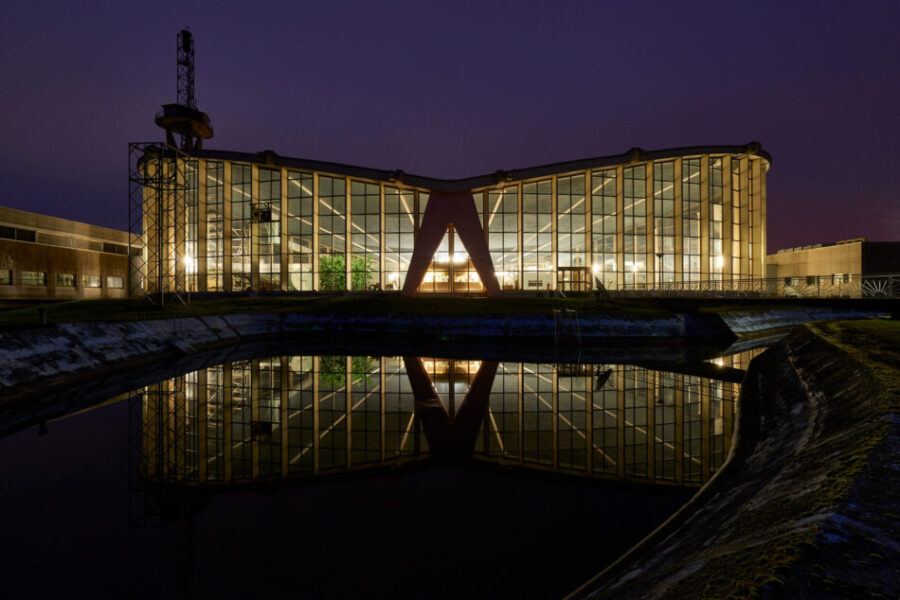
Sendehalle Europe 1
Sendehalle Europe 1
The Sky Shell of Berus
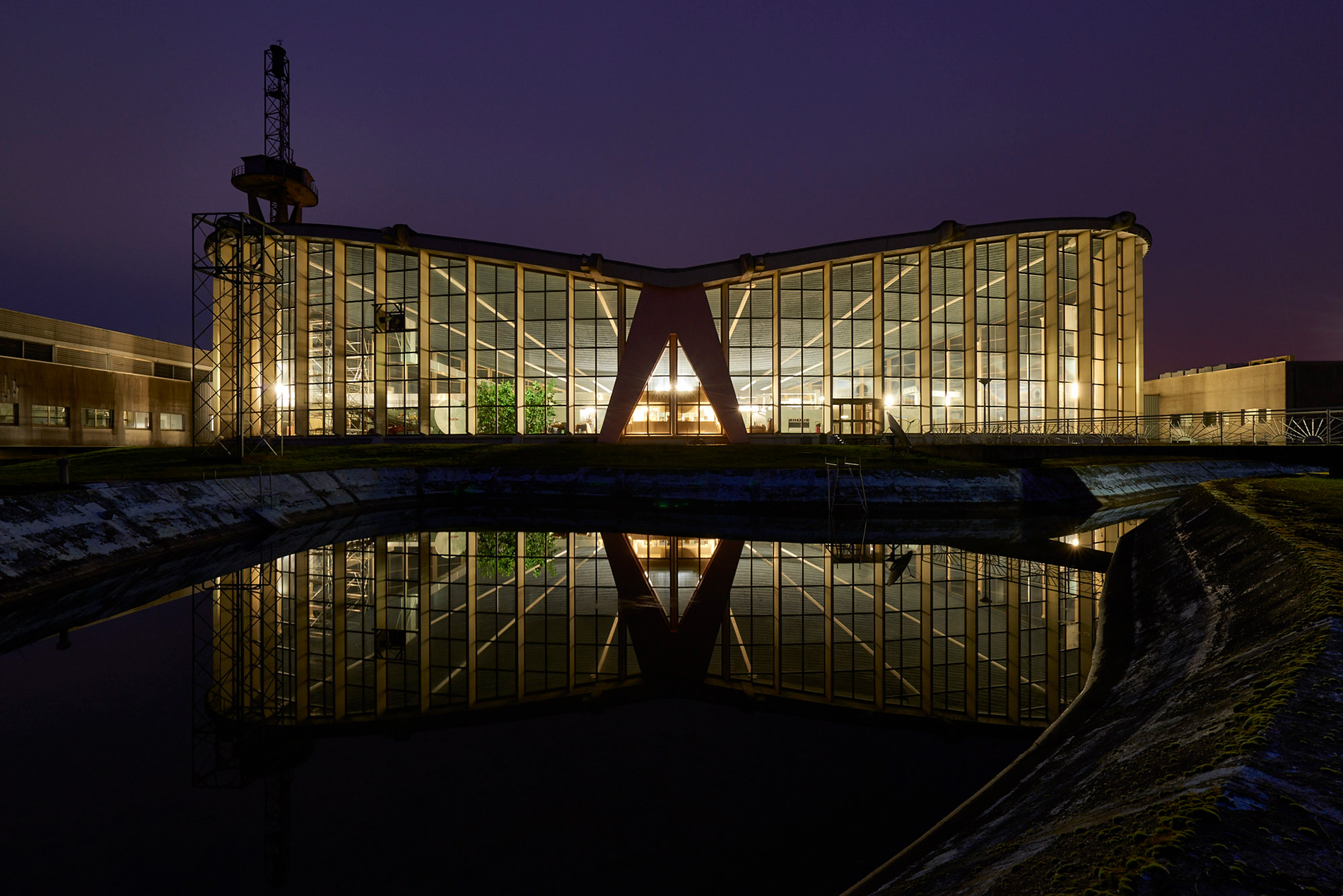
View from the west, around 2016. Photo: INIK, MKA3421
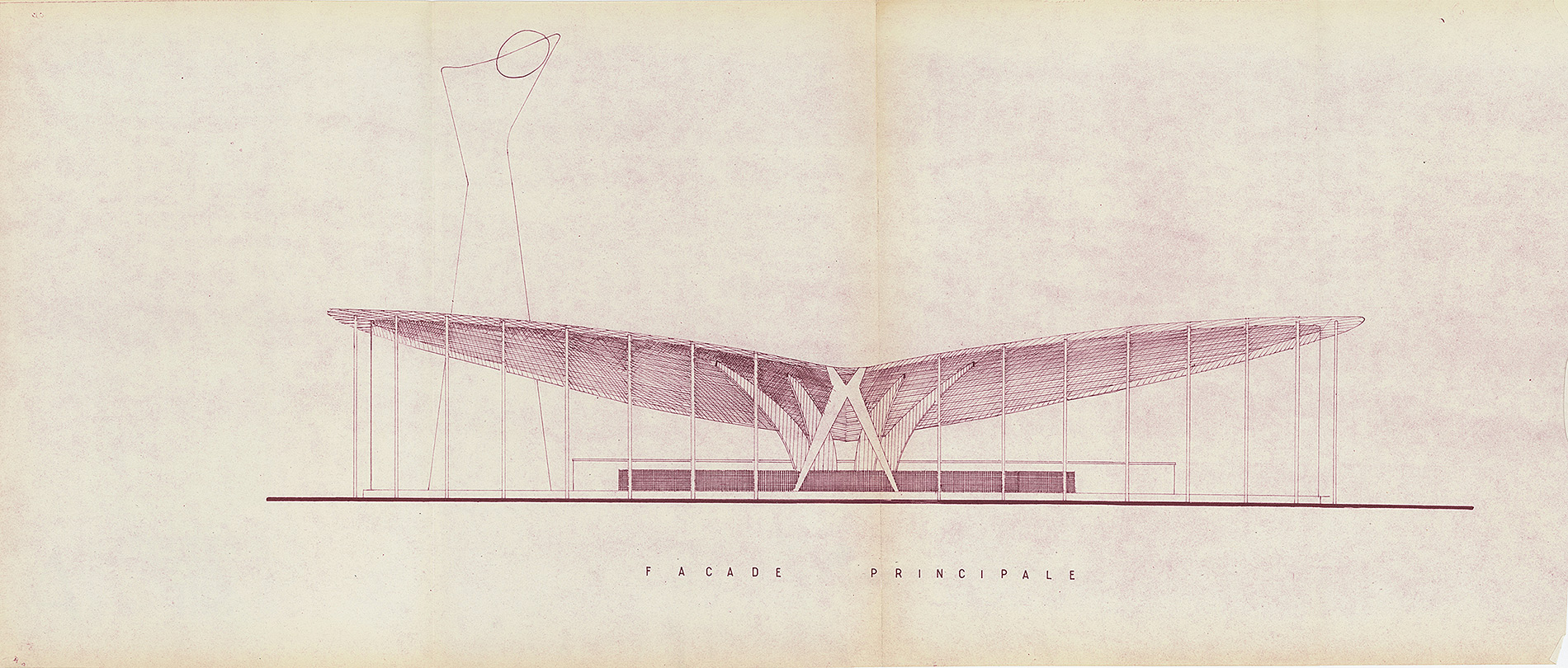
Elevation in Jean-François Guedy’s first documented design, 23 March 1954. Photo: Archiv Berus, Gemeinde Überherrn
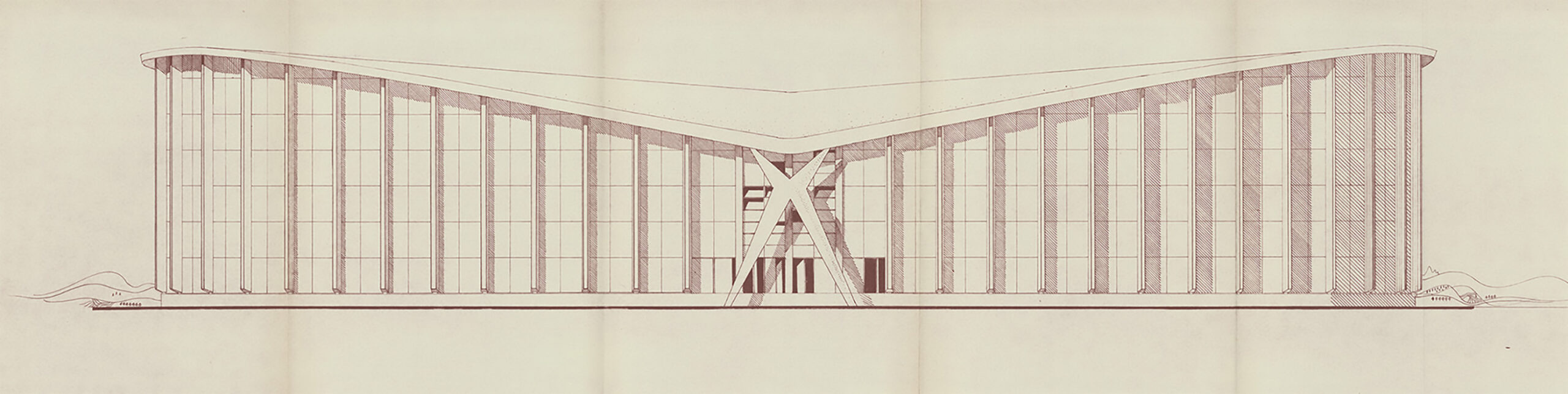
Elevation in the construction design, 27 July 1954. Photo: IFA, Fonds Laffaille, dossier... Doc. SV-18-04-18-03
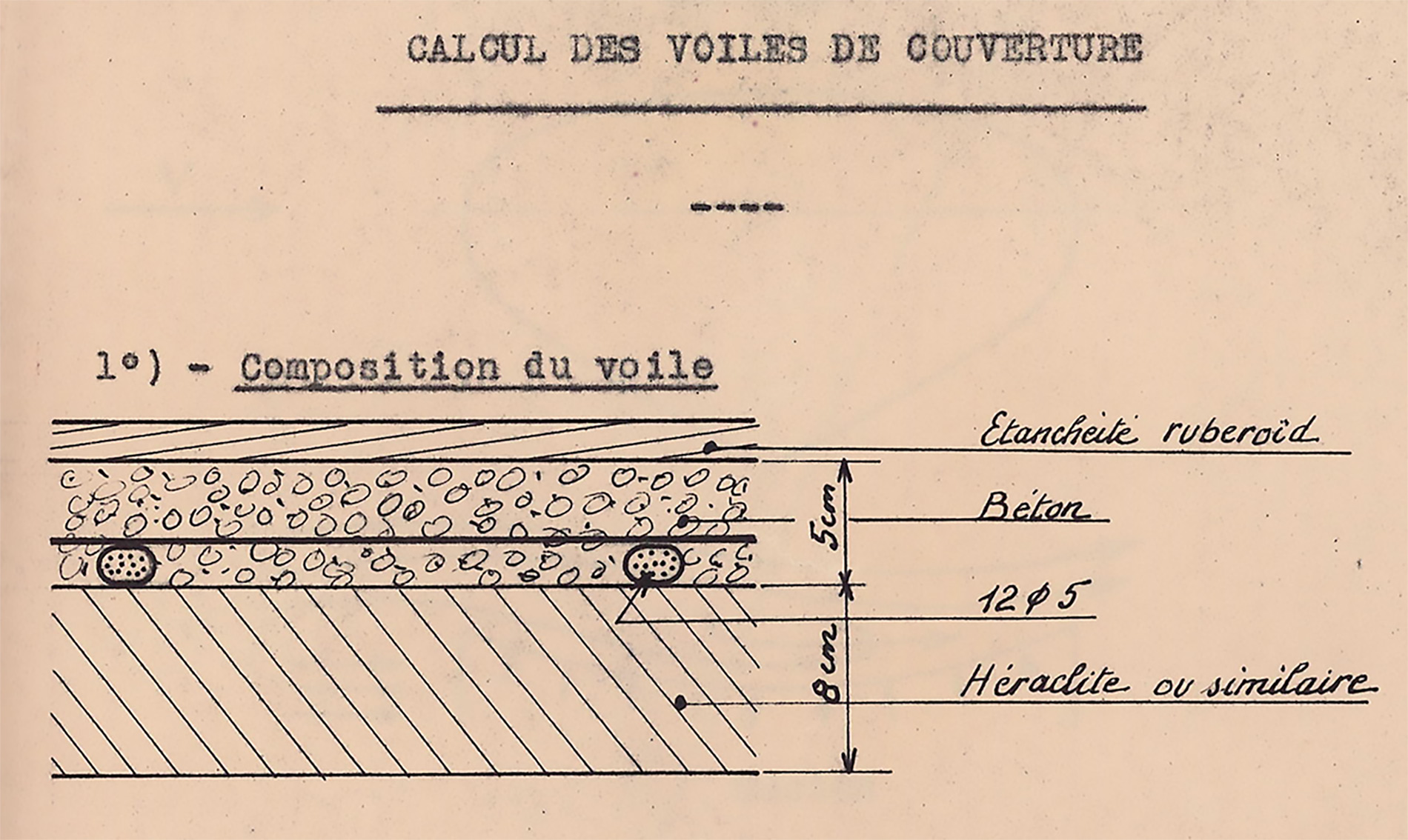
Build-up of the roof according to Laffaille, summer 1954: the concrete shell is only 5 cm thick; the tendons, each with twelve 5 mm wires, were to lie directly on the Heraklith insulation layer. Photo: Archiv Berus, Gemeinde Überherrn
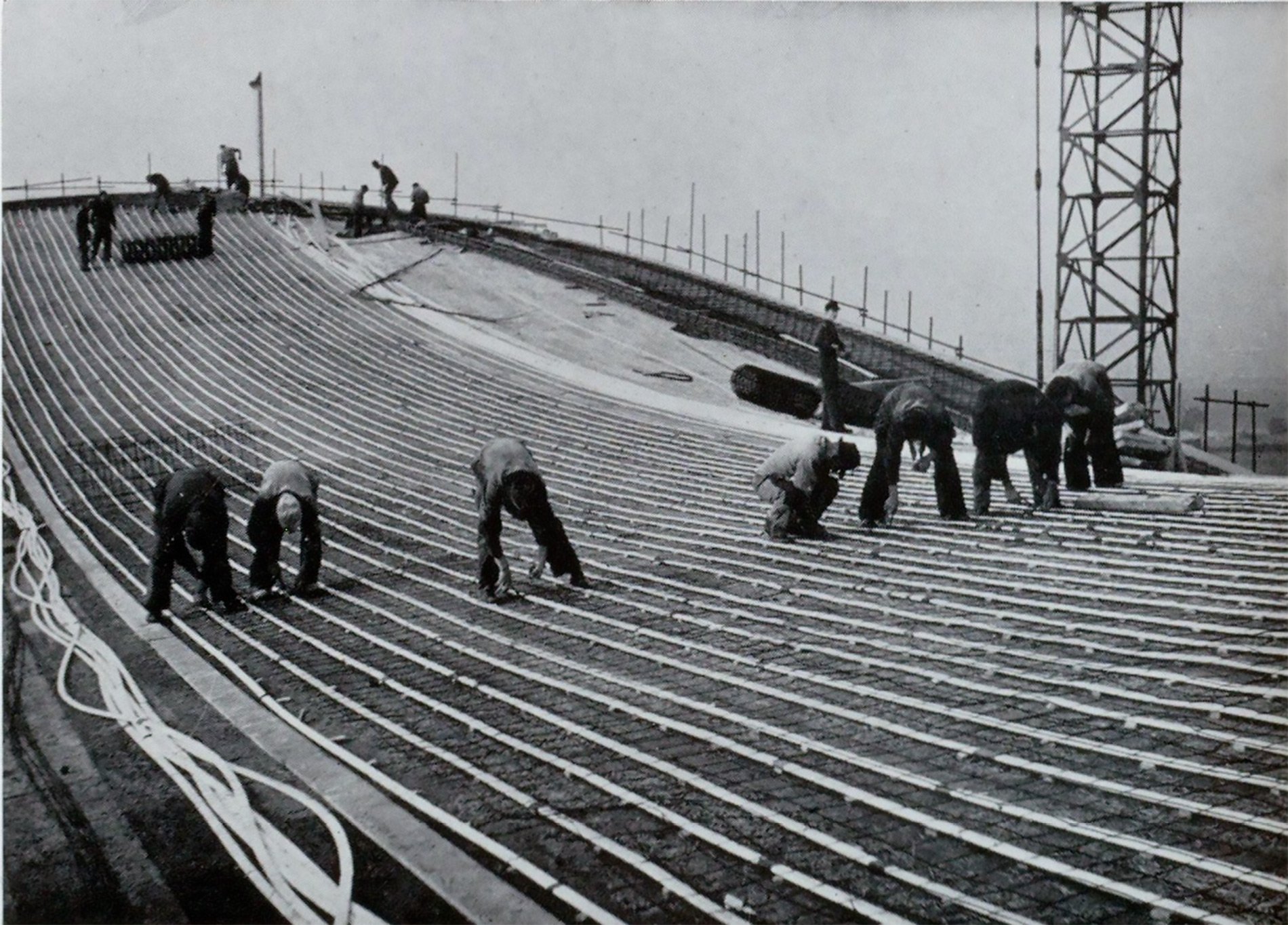
Placing the reinforcement according to Laffaille’s design, August 1954: the workers tie the ducts of the tendons to the overlying mats of light transverse reinforcement. Photo: L’Architecture d’aujourd’hui 26.1955, no. 58
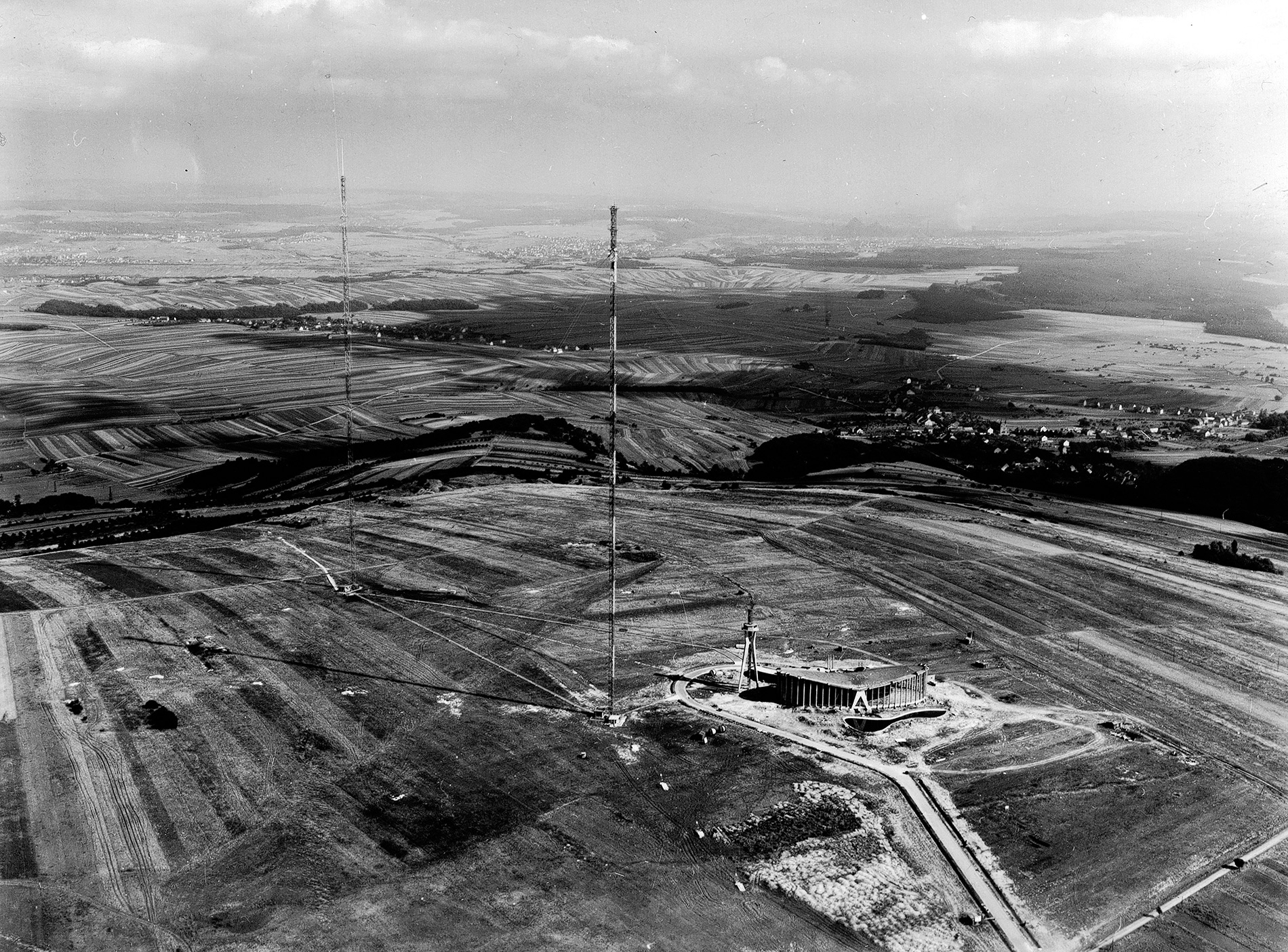
From 1976, the Europe 1 transmitting center, with a total of four long-wave transmitter masts each 280 m tall, was among the most powerful radio transmitters in the world. Photo: unknown

Today, six massive tie bars cross the space beneath the roof shell (photographed in 2017). Photo: Werner Lorenz
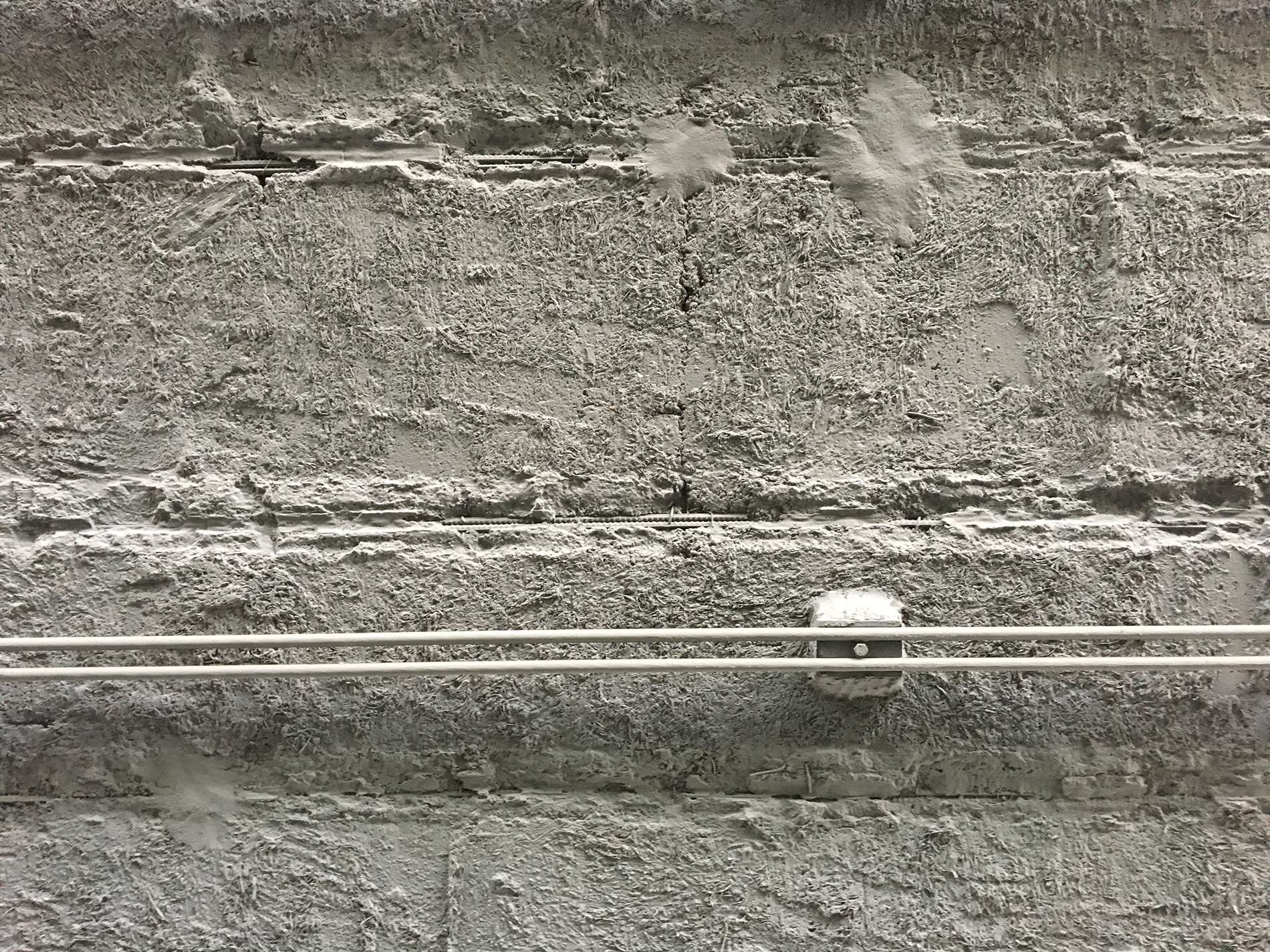
The view of the underside of the present roof shows the external tendons of 1982, arranged in pairs on spacers; visible in the slab are the remaining untensioned reinforcement of 1955 and imprints of the ducts of the old tendons (photographed in 2017). Photo: Werner Lorenz
More than two and a half thousand square meters without a single column, and floating above them a curved shell spanning a good 80 m and yet only 5 cm thick: the transmitter hall of Radio Europe 1 stands almost paradigmatically for a way of building to which there seemed to be hardly any limits. Yet its dramatic construction history equally reveals, in exemplary fashion, the dark sides of high-modern engineering – the seductive power of the ideal of maximum lightness, the progress-blind misjudgment of potential risks and, not least, the disturbing hubris of believing oneself all too safe and free from error.
Clip: Werner Lorenz, Bernard Espion: Die Sendehalle von Radio Europe 1 in Berus. Berlin 2021.
Film: The transmitter hall of Radio Europe 1 in Berus
The Building
The construction of the hall is linked to the two most important pioneers of French shell construction. For Bernard Laffaille, however, it became the site of his greatest defeat: in September 1954, the shell structure he had designed tore apart while still under construction. In spring 1955, Eugène Freyssinet succeeded in completing it with a modified concept. But his “rescue of the hall” also proved to be of little lasting value: in 1980, the delicate surface structure was once again on the verge of failure. Only at the third attempt, in 1982, was today’s more reliable structure created.
Construction
The heart-shaped plan is covered by an anticlastic surface whose inclined axis drops from 9.50 m at the front to approx. 4.50 m at the rear. It is suspended between two reinforced concrete edge arches, mirror-symmetrical about the axis; to secure them, six massive prestressed tie bars cross the space. In its third version, the shell itself is now merely “dead load”: today, load transfer is handled solely by the closely spaced under-tensioning added in 1982.
Future
At the end of 2015, Radio Europe 1 ceased operating the transmitter hall, and ownership passed to the municipality. Its future use and the related question of who will operate it remain uncertain; initial concepts have been put forward. (WL)
Key Facts
- Location: Ittersdorfer Straße, 66802 Überherrn, Berus district
- Construction: [a] 1954, [b] 1954/55, [c] 1980–82
- Structural design: [a] Bernard Laffaille with René Sarger, Bureau C.A.P.E.M., Paris, [b] Eugène Freyssinet and Yves Guyon, STUP, Paris, [c] Pierre Xercavins, Bureau Europe Etudes Gecti, Clichy, for Freyssinet International, Boulogne Bilancourt
- Overall design: Jean-François Guédy with André Nejavits-Méry, Paris
- Construction: [a] Saar Bauindustrie AG, Saarlouis; STUP, Paris; Dillinger Hüttenwerke AG, Dillingen, [b] Saar Bauindustrie AG, Saarlouis; STUP, Paris, [c] Freyssinet International, Boulogne Bilancou
- Heritage status: Entered in the list of monuments of the Saarland in 1999
Further Reading
Axel Böcker / Rupert Schreiber: “La Cathédrale des ondes – die Kathedrale der Wellen.” In: Die Denkmalpflege 74 (2016), no. 1, pp. 70–78
Deutscher Werkbund Saarland (ed.): Das Europe 1 Sendezentrum im Saarland, Berus-Überherrn (Resonanzen; 2). Merzig 2020
Werner Lorenz / Bernard Espion: Die Sendehalle von Radio Europe 1 in Berus (Historische Wahrzeichen der Ingenieurbaukunst in Deutschland; 28). Berlin 2021
Web Links
Werkbund Saarland, “Resonanzen” series
Institut für aktuelle Kunst at the Hochschule der Bildenden Künste Saar
Saarland Ministry of Education and Culture
More Information
The building is a subject of the sub-project Aged High Modernism in Reinforced Concrete (B3).
