
Mast 17 in Königs Wusterhausen
Mast 17 in Königs Wusterhausen
Mast 17 in Königs Wusterhausen
A Unique Testimony to the Pioneering Days of Radio
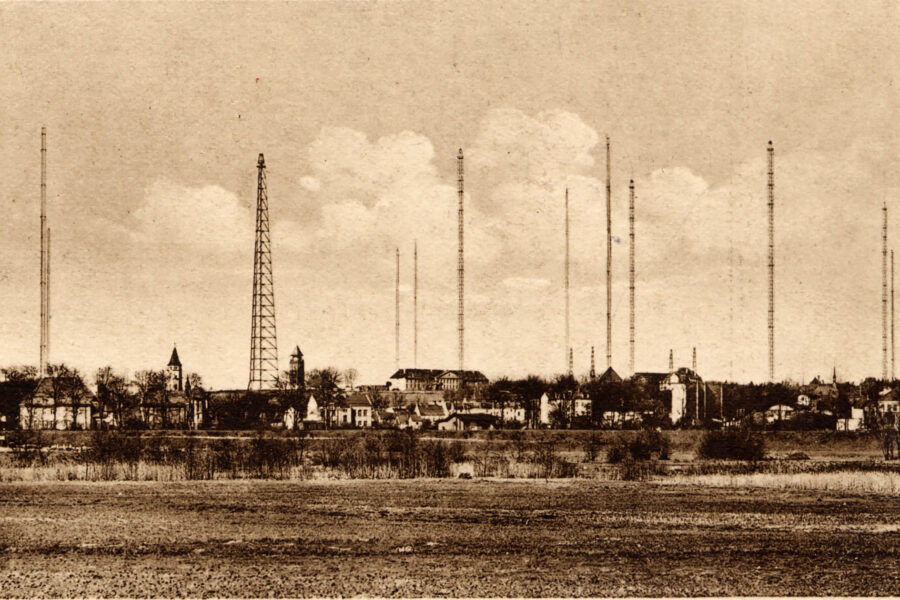
Panorama of the Funkerberg from the southeast, c. 1926. Postcard no. 1428, published by W. Meyerheim, 1932.
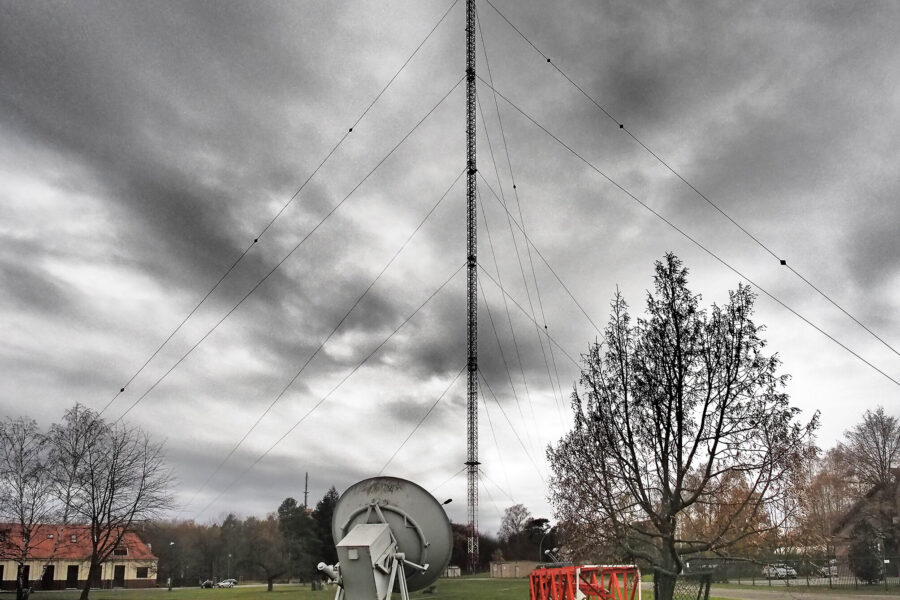
General view of Mast 17 from the southeast; in the foreground, parts of a former RIAS transmitter mast from Berlin-Britz, 2016 (www.funkerberg.de). Photo: Thomas Wiegold
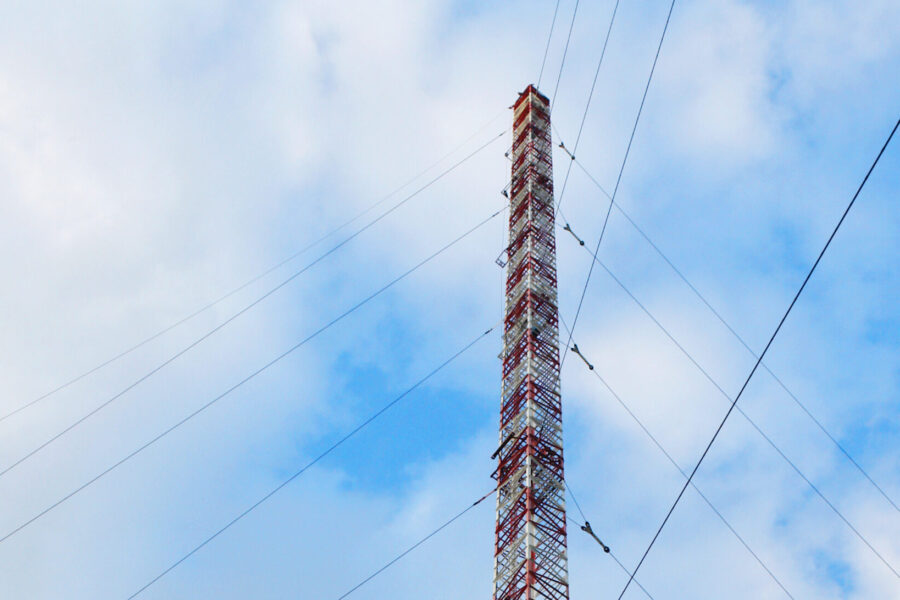
Mast 18, looking southwest, 2006. Photo: Pete Shacky.
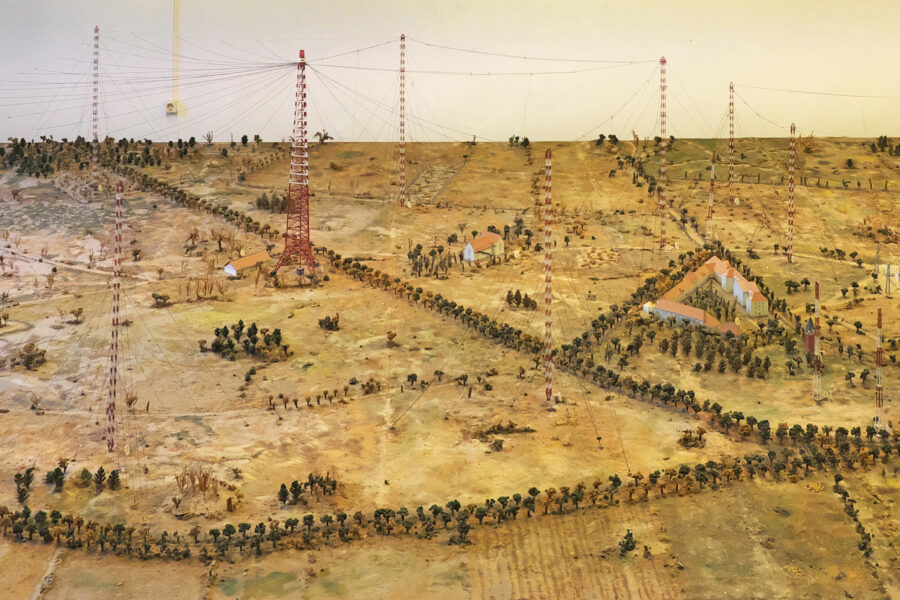
Model of the Funkerberg in 1938/39. Mast 6 (later Mast 17) is in the center of the image, above the trapezoidal building complex of the former radio barracks. The blue triangle marks the tower. Wikimedia Commons, V. Boldychev, 2021.
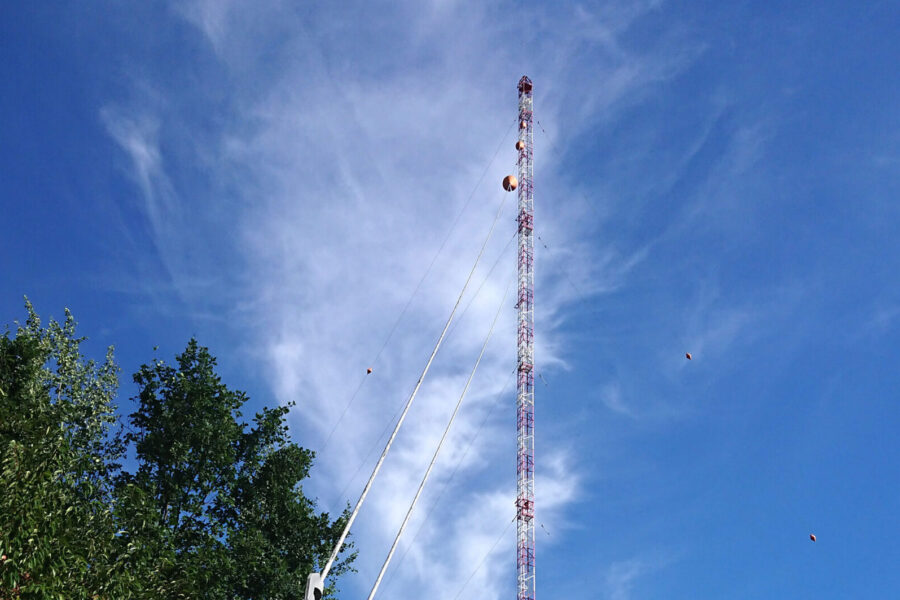
View from the south of Mast 17 from the anchor point of the two outer guy cables, 2021. Sender- und Funktechnikmuseum Königs Wusterhausen (Museum of Transmitter and Radio Technology)
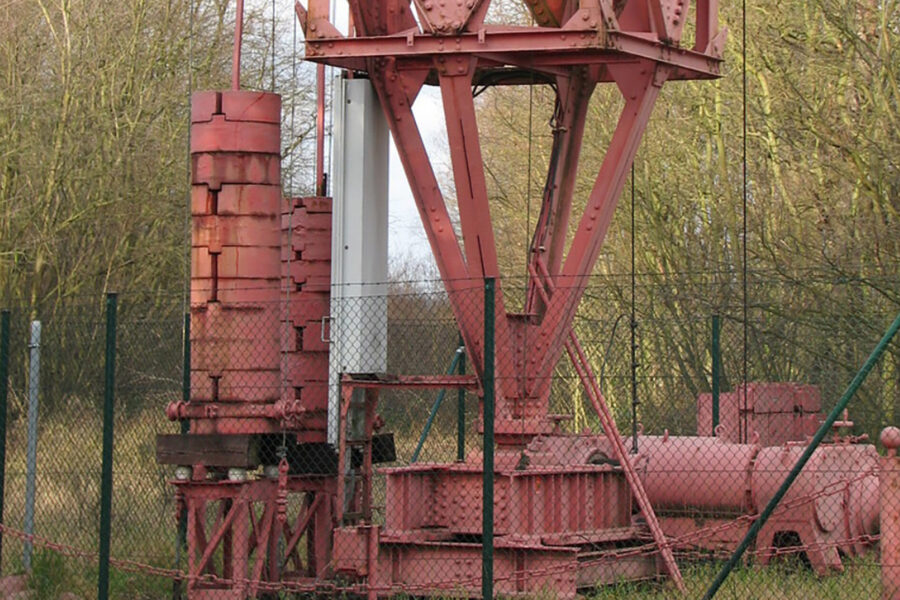
Base of Mast 17 with counterweights of the former antenna cable, 2007. Photo: Steffen Kahl
Together with five other masts and a free-standing tower at the center, “Mast 17,” erected at the end of 1924, carried the antennas of the new long-wave transmitter at Königs Wusterhausen. Today the “skyscraper,” almost 215 m tall, is a unique testimony – and not only to the pioneering years of radio broadcasting.
The Building
In late December 1920, the “Hauptfunkstelle” (main radio station) Königs Wusterhausen broadcast a Christmas concert, which is regarded as the nucleus of German radio broadcasting. Soon afterwards, the facility, with some 20 telegraphy and telephony transmitters whose antennas were strung between seven support masts up to 150 m tall, was already bursting at the seams.
Between 1922 and 1925, a generous extension was carried out in two construction phases, its most conspicuous element being a huge steel tower. It was surrounded, in an irregular hexagon, by six lattice masts, each around 215 m tall. Together they carried the huge antennas for the long-wave transmitters of the new transmitter buildings 2 and 3.
The so-called central tower rose 243 m into the sky (280 m had even been planned), making it the second-tallest free-standing structure of its time after the Eiffel Tower. Weighing 700 t, however, it was only one tenth as heavy as the French record holder. The daring structure was the work of Honnefwerke AG, which also erected the associated masts 1 and 4. Masts 2, 3 and 5 were based on concepts by the Swedish engineer Karl Ljungberg; mast 5 initially stood at the center of the facility until the central tower was completed. The three masts may have been erected by the renowned Berlin steel construction firm Hein, Lehmann & Co.; in any case, the firm ultimately contributed mast 6, to its own design, in the course of a second extension phase.
Construction
The company had been working on support masts for the antennas of the newly invented wireless telegraphy since as early as 1904. Among other things, Hein, Lehmann & Co., together with Telefunken, developed the world’s first large-scale radio station in Nauen, west of Berlin. There, several basic principles emerged for the antenna supports, which were rapidly growing ever taller: a slender steel lattice body with several guy cables, an articulated point bearing to compensate for oscillations, insulation from the ground by porcelain bodies, and antenna cables supported so as to be movable and kept under constant, even tension by concrete weights.
Whereas triangular cross-sections had still been used at Nauen, those at Königs Wusterhausen were all square. This also applied to mast 6, with its 2.30 m sides, even though for reasons of space it could only be guyed on three sides. In 1924 it was assembled within two months from around 90 t of steel angles and secured with 18 guy cables up to 280 m long.
Future
At the end of the 1930s, no fewer than 22 antenna supports rose into the sky on the “Funkerberg” in Königs Wusterhausen. Fifteen years later, their number had already been halved. Further dismantling followed, owing to reduced demand and concerns about structural stability after the central tower collapsed during a hurricane-force storm at the end of 1972. In the end, only the former mast 6 survived, as it was still needed until 1995 to carry an inclined-wire antenna for a long-wave transmitter. Since then, an active friends’ association has been looking after the preservation of the structure, renamed Mast 17 in the meantime, as well as the numerous other relics of broadcasting history on the Funkerberg. An extensive refurbishment of the oldest large antenna support in Germany is currently being prepared.
Key Facts
- Location: Königs Wusterhausen, Funkerberg
- Construction: 1924/25
- Refurbishments: 2007, 2009/10
- Structural design: Hein, Lehmann & Co. AG, Berlin-Reinickendorf (head: Franz Bräckerbohm)
- Heritage status: Entered in the list of monuments of the State of Brandenburg in 1994.
Further Reading
- W[alter] Meyer: Telefunken in Königswusterhausen. 3rd ed., Berlin 1928.
- Otto Lemke: “Königs Wusterhausen. Von der militärischen Zentralfunkstation zur postalischen Hauptfunkstelle.” In: Archiv für das Post- und Fernmeldewesen 20 (1968), no. 2, pp. 115–163.
- Gerd Klawitter (ed.): 100 Jahre Funktechnik in Deutschland: Funksendestellen rund um Berlin. 3rd ed., Dessau 2004, pp. 61–92.
- Christine Oliwkowski: “Die Hauptfunkstelle Königs Wusterhausen – ‘[…] wegen ihrer Vielgestaltigkeit die interessanteste Funkstation der Welt’.” In: Felix Engel / Kristina Hübener (eds.): Königs Wusterhausen. Eine Stadtgeschichte. Berlin 2020, pp. 267–297.
Web Links
Mast 17 on the website of the Funkerberg Museum in Königs Wusterhausen
